Ducting installation for Air-con& Ventilation (Ductwork)
ChatGPT said:
It looks like you’re asking about ducting installation for air-conditioning and ventilation, often referred to in construction and MEP (Mechanical, Electrical, and Plumbing) works as “ductwork.” Here’s an overview of what’s typically involved in ductwork installation for HVAC systems (Heating, Ventilation, and Air Conditioning):
🔧 Ducting Installation for Air-Con & Ventilation (Ductwork)
1. Planning & Design
System Design: Based on cooling/heating load, air changes per hour, and occupancy.
Duct Layout: Includes main ducts, branches, risers, and returns. Should avoid sharp bends to reduce resistance.
Sizing: Proper sizing is crucial to maintain air velocity, reduce noise, and ensure energy efficiency.
Standards: Follow SMACNA, ASHRAE, or local codes.
2. Types of Duct Materials
GI (Galvanized Iron): Common in commercial and residential systems.
Aluminum: Lightweight and corrosion-resistant.
Flexible Ducts: Used for short runs and difficult bends.
Pre-insulated Panels: For quick installation and thermal efficiency (e.g., Phenolic, PIR).
3. Fabrication
Sheet Metal Cutting: Using CNC plasma machines or manual cutting.
Assembling: Flanges, reinforcements, and sealing with gaskets.
Accessories: Volume dampers, access doors, turning vanes.
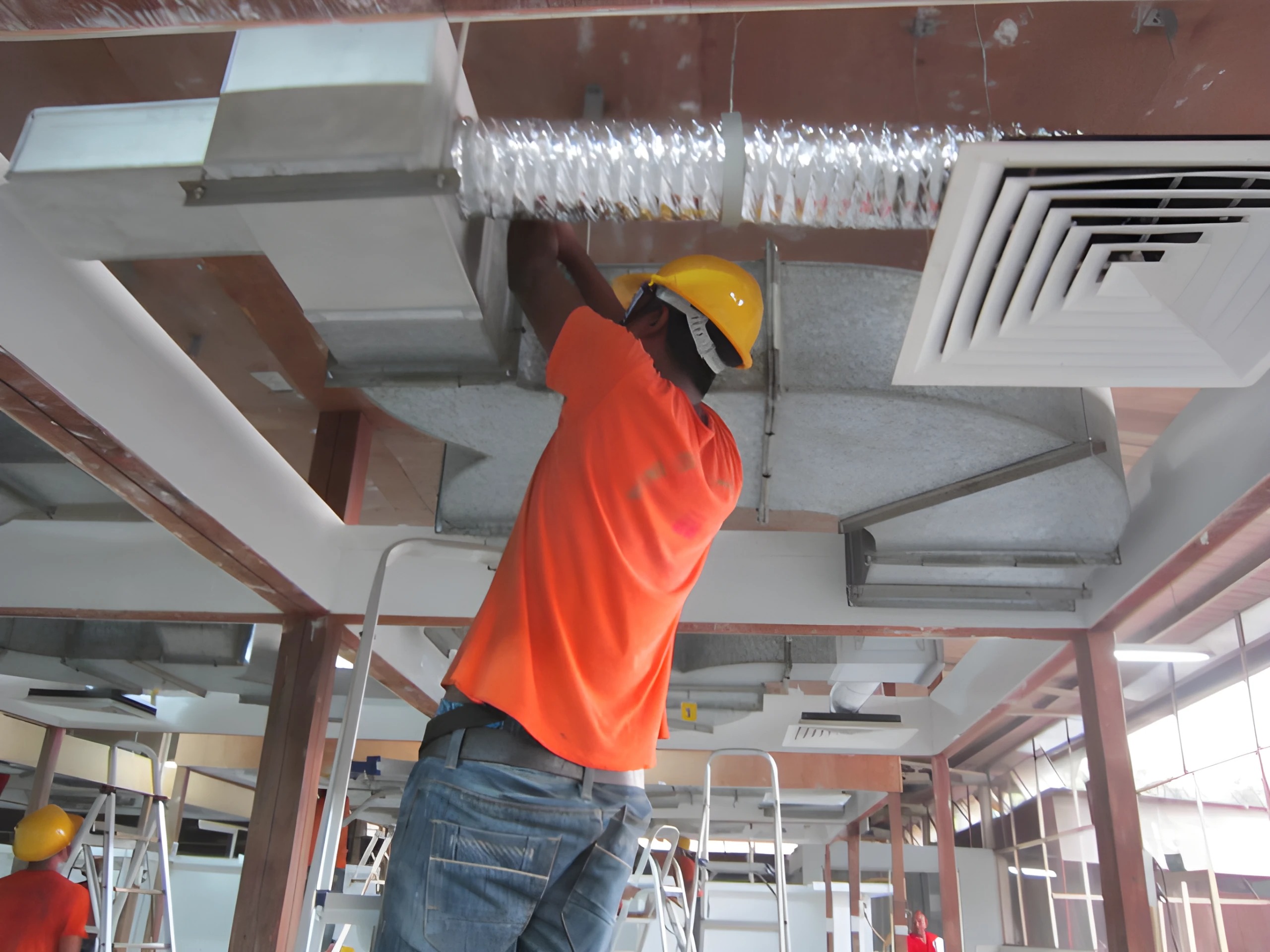
4. Installation Process
Marking & Leveling: As per shop drawings.
Support System:
Hangers, brackets, or trapeze supports with vibration isolators.
Duct Placement:
Horizontal ducts hung from the ceiling; vertical ducts supported at each floor.
Sealing Joints:
Use of sealants, gaskets, or tapes to ensure airtightness.
Insulation:
Thermal insulation (e.g., fiberglass or elastomeric foam).
Acoustic insulation where needed.
Fire Dampers & Smoke Dampers:
Installed at fire-rated wall penetrations as per code.
Grilles, Diffusers & Registers:
Connected to duct ends for air distribution.
5. Testing & Commissioning
Air Leakage Test: Especially for high-pressure ducts.
Balancing: Airflow is adjusted using dampers to ensure designed flow rates.
Commissioning Report: Final verification and handover documentation.
6. Safety & Best Practices
Use PPE (gloves, goggles, safety shoes).
Keep ducts clean during installation to avoid contamination.
Coordinate with other trades (electrical, plumbing, structural) to avoid clashes.
PLEASE CONTACT US FOR FURTHER INFORMATION
SB Group
- Beroon, Jamgora, Ashulia, Dhaka, Bangladesh.
- Email: fondaglobaltestcenter@gmail.com
- Phone: +880255035512